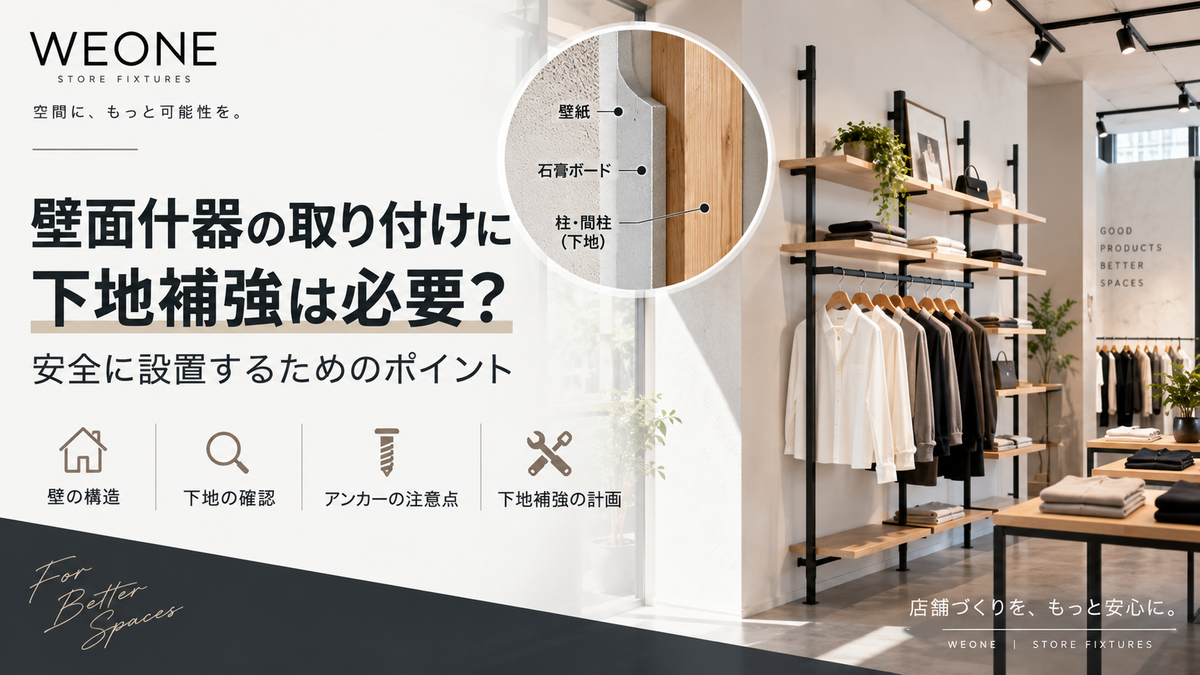
Do You Need Wall Backing for Installing Wall Fixtures? Key Points for Safe Installation
When installing wall-mounted fixtures such as wall-mounted hanger racks or display racks, many people wonder, "Is it okay to fix them anywhere on the wall?", "Can I just drive screws directly into the plasterboard?", or "Is reinforcement (backing) necessary?"
To ensure the stable use of wall-mounted fixtures, it is important not only to consider the specifications of the fixture itself, but also to check the structure of the wall and the condition of the backing (studs) where it will be installed.
In particular, for store fixtures, one must account for not only the weight of the unit itself, but also the weight of the clothing and products displayed, as well as the forces applied through daily use.
This article provides an easy-to-understand guide on the basics of "wall backing" that you should know before installing wall fixtures, how to check for it, and what to consider if there is no backing at the desired location.
Table of Contents
- What is "wall backing" anyway?
- First, let's check the structure of the wall where you intend to install
- How to check for the location of backing
- Consider not just the "weight of the fixture," but also the "load during use"
- Wall fixtures should ideally be "fixed to the backing"
- What if there is no backing at the desired mounting position?
- Can I skip the backing if I use drywall anchors?
- Plan "backing reinforcement" in advance for new construction or store renovations
- If you are unsure of the wall structure, check with a contractor
1. What is "wall backing" anyway?
In standard interior walls, wall materials such as plasterboard are installed on the surface, with structural elements like pillars and studs located inside.
These parts inside the wall where screws and other fasteners can be securely anchored are generally referred to as "backing."
While plasterboard is widely used as an interior material, it is relatively soft, so simply driving standard screws into the plasterboard alone may not provide enough holding power.
Therefore, when securing heavy fixtures to a wall, the basic principle is to identify and secure them to structural members like pillars or studs that offer sufficient strength.

2. First, let's check the structure of the wall where you intend to install
Before installing wall-mounted fixtures, the first thing you need to check is the structure of the building and the wall.
Buildings and walls come in various types, including:
Wood construction
Steel construction
Concrete construction
Partition walls using plasterboard
Each of these has different internal structures, backing positions, and materials.
Therefore, you cannot apply a one-size-fits-all rule for backing spacing or required reinforcement methods. It is important to consider the appropriate fixing method based on the wall type, structure, weight of the fixture, and how it will be used.
If you are installing fixtures in an existing store or home, ensure you check the actual wall structure, the location of the backing, and its strength before beginning installation.
3. How to check for the location of backing
In a finished wall, it can sometimes be difficult to tell the location of pillars or studs just by looking at it from the outside.
A stud finder (backing detector) is very useful in such situations.
Typical types include sensor-based and needle-based detectors.
Sensor Type
This type detects the location of backing inside the wall by moving the device along the wall surface.
Depending on the product, some can detect not only wood but also metal and electrical wiring.
Needle Type
This type involves inserting a thin needle into the wall to check for the presence of backing based on how the needle penetrates.
If there is backing behind the plasterboard, the needle will stop, serving as a guide to identify the location.
While you can also estimate the location of the backing by the sound when tapping on the wall, using a dedicated stud finder is the safest way to confirm it accurately.

4. Consider not just the "weight of the fixture," but also the "load during use"
When considering how to secure a fixture to the wall, it is also important not to judge based solely on the weight of the fixture itself.
For example, in the case of a hanger rack:
Weight of the unit + shelves + hangers + clothing, bags, and products
...all add to the load.
Furthermore, when hanging or removing products, temporary force and vibration are applied to the mounting points.
Therefore, large-scale wall fixtures or display fixtures must be considered differently from lightweight items like photo frames or small hooks.

5. Wall fixtures should ideally be "fixed to the backing"
At WEONE, for wall-mounted fixtures, we recommend fixing them to areas with sufficient strength, such as pillars or studs, as a basic rule.
For example, some of WEONE's floor-standing wall fixtures are designed to support the load of the unit on the floor, with the top part fixed to the wall to ensure stability.
Even in such cases, it is crucial to secure the wall-side mounting points to the backing where screws can grip firmly.

6. What if there is no backing at the desired mounting position?
Depending on the fixture's design or the layout of the store, the mounting points of the fixture may not align with the internal pillars or studs.
One method in such cases is to use a backing plate (base plate).
Secure a high-strength backing plate to the locations where there is internal backing (pillars/studs), and then mount the fixture or bracket via that backing plate.
This allows you to accommodate situations where the fixture's mounting points do not match the internal wall structure.
Note, however, that the material, thickness, and mounting method of the backing plate itself must be considered according to the fixture and wall structure.
7. Can I skip the backing if I use drywall anchors?
There are various types of drywall anchors used to fix screws in places where there is no backing.
However, the supported wall material, wall thickness, screw diameter, load capacity, and installation conditions vary for each type of anchor.
Especially for large store fixtures, it is necessary to consider the weight of the fixture, the weight of the displayed items, the number of mounting points, the force applied during use, and the structure of the wall in a comprehensive manner.
Therefore, "using drywall anchors" does not mean that every wall fixture can be installed anywhere.
For large or heavy fixtures, fix them to backing with sufficient strength whenever possible. If you do use anchors, please check the product specifications and installation conditions.
If you are unsure, we recommend consulting with a contractor.

8. Plan "backing reinforcement" in advance for new construction or store renovations
If you are planning to build a new store or renovate an existing one, it is smooth to decide on the fixture installation positions in advance.
Before finishing the walls, you can tell the construction company, "We plan to install wall fixtures in this location," and have them plan for backing reinforcement to align with the fixture's mounting points.
Considering the placement of fixtures at the design stage helps prevent post-completion problems like "there is no backing where I want to install it."

9. If you are unsure of the wall structure, check with a contractor
The appropriate method for securing wall fixtures depends on the building and wall structure, the size and weight of the fixture, and how it is used.
In particular, when installing large fixtures, heavy items, or fixtures displaying many products, prioritize safety and consult with a construction company or a specialist if necessary.
Also, keep in mind that electrical wiring and plumbing may pass inside the walls. You must be very careful about the situation inside the wall when drilling or fixing screws.
To Customers Considering WEONE Wall Fixtures
At WEONE, we offer display fixtures and hanger racks tailored to various store spaces, including apparel shops, select shops, and showrooms.
If you have any questions regarding the installation of wall fixtures, please let us know the product you are considering and the situation at your planned installation site.
We will provide guidance on the appropriate mounting method based on the product specifications.
※Because wall structures and strengths vary from site to site, please confirm the final construction method with your contractor.